

You can’t see bacteria in your water. That’s the problem.
Canadian homeowners on wells worry about coliform contamination. Lake cottage owners deal with murky water after storms. Even municipal users get boil-water advisories that last days or weeks.
Choosing the wrong water filtration systems in Canada means you’re still drinking contaminated water. Or you spent thousands on equipment that doesn’t fix your actual problem.
Let’s match common Canadian water issues to the right solutions.
Bacteria and Microorganisms: UV Disinfection
Wells and lake water can harbor E. coli, coliform bacteria, viruses, and parasites like Giardia or Cryptosporidium. These make people sick. When shopping for water filtration systems Canada homeowners need to understand that UV disinfection targets these biological threats specifically. UV systems use ultraviolet light to inactivate these organisms. Water flows through a chamber with a UV lamp. The light damages microbial DNA so they can’t reproduce or cause infection.
UV doesn’t remove anything from the water. It just makes living organisms harmless. This matters because you still need to address sediment, taste, odor, and chemicals separately.
UV works best when:
- Your water is clear (less than 5 NTU turbidity)
- You have a pre-filtration to remove particles.
- The system is sized correctly for your flow rate.
Canadian cottage owners often pair a sediment filter and a carbon filter before the UV unit. This setup handles most lake and surface water challenges.
Flow rate sizing is where people make mistakes. A system rated for 10 gallons per minute (GPM) won’t deliver a proper UV dose if you’re pulling 12 GPM during peak use. Undersizing means inadequate disinfection.
Check your peak flow by running multiple taps and appliances at once. Size the UV system to handle that maximum demand.
Sediment, Dirt, and Cloudiness: Mechanical Filtration
Sediment filters catch visible particles. Sand, silt, rust, and debris get trapped before they reach your taps or damage appliances.
These filters use rated micron sizes. A 5-micron filter catches particles down to 5 microns. Smaller numbers mean finer filtration.
Most homes need two stages. A 20 or 30-micron filter is first to catch larger debris. Then, a 5-micron filter is used to polish the water.
Change these cartridges regularly. Clogged filters reduce water pressure and can burst under high pressure. Mark your calendar for every 3 to 6 months, depending on water quality.
Wells with high sediment might need a centrifugal separator or settling tank before the filters. Lake water during spring runoff often requires more frequent cartridge changes.
Heavy Metals, Nitrates, and High TDS: Reverse Osmosis
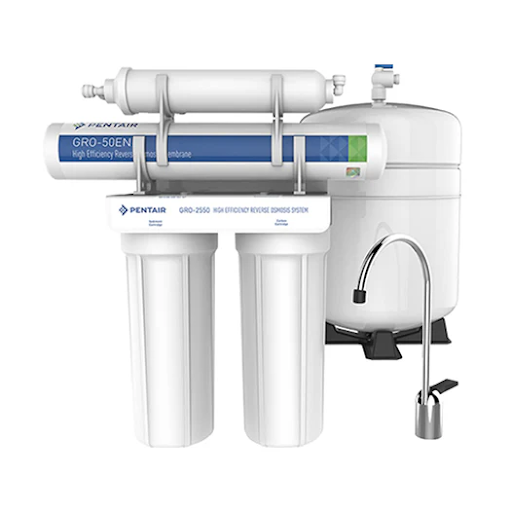
Reverse osmosis (RO) systems push water through a semipermeable membrane. This removes dissolved solids, including lead, arsenic, nitrates, fluoride, sodium, and most other contaminants.
RO produces very pure drinking water. But it wastes water in the process. For every gallon of clean water, you might send 3 to 4 gallons down the drain during the filtering process.
Install RO at the point of use, usually under the kitchen sink. Running your whole house through RO makes no sense. You don’t need ultra-pure water for toilets and laundry.
Canadian rural homes with high nitrate levels from agricultural runoff need RO. Wells testing positive for arsenic or lead absolutely require it. Municipal users concerned about trace pharmaceuticals or specific dissolved metals also benefit.
RO membranes last 2 to 3 years. Pre-filters and post-filters need changing every 6 to 12 months. Budget for maintenance when considering these systems.
Iron Staining and Odor: Specialized Filtration
High iron creates orange or brown staining on fixtures, laundry, and dishes. Water might look clear coming out of the tap, but it turns color as it sits.
Iron filters use oxidation and filtration to remove dissolved and particulate iron. Air injection systems work well. So do catalytic media filters with manganese dioxide.
Sulfur gives water a rotten egg smell. It’s disgusting but not necessarily dangerous. Treatment depends on whether you have hydrogen sulfide gas or sulfur bacteria.
Carbon filters help with low levels of hydrogen sulfide. Chlorination or ozone systems handle higher concentrations. Aeration can release the gas before filtration.
These problems frustrate homeowners because standard filters don’t touch them. You need equipment specifically designed for iron and sulfur removal.
Next Steps
Order a water test if you haven’t already. Results guide every decision that follows.
List your specific concerns. Bacteria? Taste? Staining? Each problem needs its own solution.
Research systems rated for Canadian conditions. Cold water temperatures affect some treatment methods. Seasonal cottages need freeze protection.
Talk to a water treatment specialist who can review your test results and recommend a complete system. Guessing costs money when you buy the wrong equipment.
Clean water protects your family’s health and your home’s plumbing. Match your filtration system to your actual water problems, and you’ll get reliable results.
Contact a water treatment specialist if you need help interpreting test results or choosing equipment for your situation.