

An HA concentration is a useful starting point for comparing fillers, but it cannot describe a gel on its own. It tells a buyer how much hyaluronic acid is stated to be present in a given volume. It does not independently establish firmness, cohesivity, water uptake, or performance in tissue. Those characteristics depend on the finished formulation and the methods used to evaluate it.
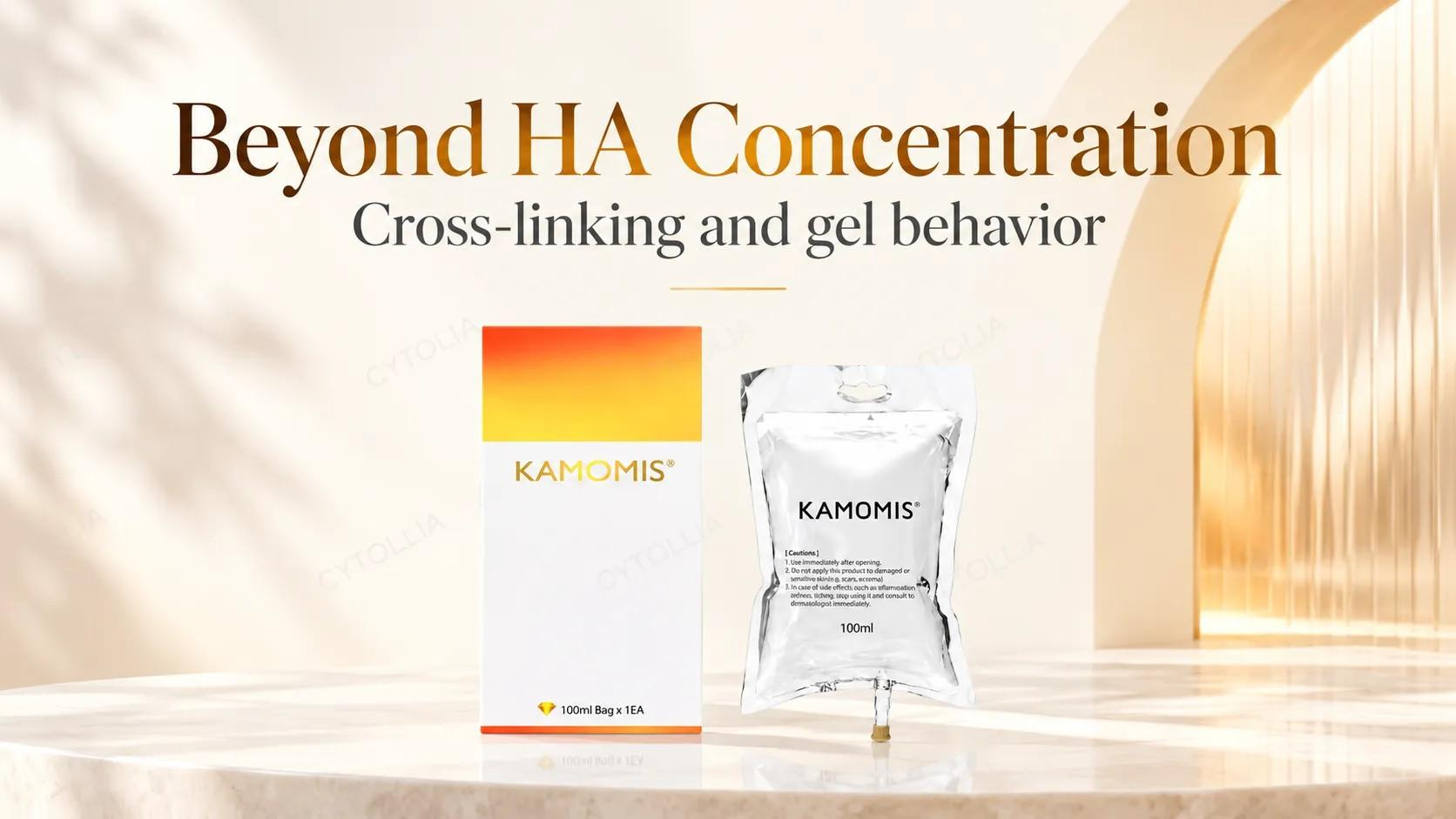
Kamomis provides a practical example of why this distinction matters. A large pack and a familiar concentration can make a product seem easy to compare with another HA filler. In reality, the comparison becomes meaningful only after the package identity, formulation, and available measurements have been separated. A technically useful review asks what each specification actually answers and which questions remain open.
Start with the exact presentation
The listing for Kamomis body filler describes a 100 mL cross-linked HA product and states an HA concentration of 20 mg/mL. Treat those as seller-provided specifications to reconcile with current manufacturer documentation. They do not constitute an independent laboratory characterization of the gel or establish equivalence to another product with the same stated concentration.
There is also a concrete packaging detail to resolve. The displayed product image identifies a 100 mL bag presentation, while the listing text uses the word vial. A bag and a vial are different package descriptions. Before comparing quotations, ask which presentation the supplied stock uses and request its current label. The clarification should appear in the purchasing record, rather than remain an informal assumption.
This discrepancy illustrates a wider point: product identity comes before performance comparison. Neither the product category name nor the appearance of a container establishes the applicable route, intended use, or handling requirements. Those belong to the documentation for the exact supplied version. A neatly completed comparison sheet is only useful if every column describes the same identifiable item.
Concentration describes quantity within the gel
The unit mg/mL expresses mass per volume. If two products both declare 20 mg/mL of HA, the statements concern the nominal amount of HA in each milliliter. They do not explain how the polymer chains are arranged, how the material was processed, or which fraction contributes to a particular gel structure. The same headline concentration can therefore accompany different physical behavior.
A useful analogy is comparing two fabrics by the weight of material per square meter. The measurement matters, but the weave changes how the fabric stretches and drapes. In an HA gel, polymer organization and formulation also influence behavior. The analogy is limited, but it helps prevent the common error of treating a quantity measurement as a complete mechanical description.
Concentration should remain in the comparison because it is a real formulation parameter. The mistake is asking it to answer every other question. If the aim is to compare elastic behavior, request suitable mechanical measurements. If the aim is to compare a clinical outcome, look for studies of the finished products. A larger concentration number cannot supply either missing dataset.
Crosslinking needs a more precise explanation
Cross-linking connects polymer chains into a network. The term describes a formulation approach, but it does not specify one universal gel structure. A review of commercial HA filler properties discusses how manufacturing and physicochemical characteristics contribute to differences among products. It also demonstrates why a product comparison needs several measurements and clear definitions. [1]
Terms such as cross-linking technology, degree of modification, and degree of cross-linking should not automatically be treated as synonyms. A chemical measurement may describe a different feature from a mechanical test. When a brochure gives a percentage, the next question is what was measured and how. Without that definition, two percentages on different brochures may not be directly comparable.
For Kamomis, the useful statement is that the seller describes the product as cross-linked HA. A specific claim about its network density, residual cross-linking agent, or superiority over a named competitor would require additional evidence. Do not fill those gaps using specifications from another brand merely because the products share a concentration or a broad category description.
Four properties that answer different questions
| Property | Question it helps answer | Information needed for comparison |
| HA concentration | How much HA is stated per unit volume | Units and formulation definition |
| Elastic modulus | How the gel responds elastically under a test | Frequency, temperature, and test method |
| Cohesivity | How the gel holds together under defined conditions | Assay and scoring or measurement system |
| Water uptake | How much fluid the gel takes up in a specified test | Medium, timing, and calculation method |
Elastic modulus, often written as G′, is frequently described in sales material as firmness. That shorthand can be convenient, but a measured value belongs to a particular test. A report should identify the conditions sufficiently well for another laboratory to understand the result. Ranking products from isolated numbers collected under different conditions can create precision without a valid comparison.
Cohesivity concerns how a gel holds together, while elasticity concerns its response to deformation. They should not be collapsed into a single quality score. Water uptake adds another dimension. A laboratory swelling result also should not be relabeled as the amount of swelling a person will experience. Tissue conditions and clinical outcomes require their own evaluation rather than a direct conversion from a laboratory beaker.
Why test methods belong beside the results
A study evaluating eight HA fillers used separate assessments of hydrophilic, cohesive, and physical properties. Its design illustrates the value of examining more than one characteristic. The findings describe the tested products under the reported conditions; they do not provide missing Kamomis measurements. The appropriate lesson is methodological: request a defined test rather than assigning a property from a marketing adjective. [2]
Suppose one specification sheet reports an elastic modulus without a temperature or frequency, while another provides a full protocol. The incomplete number should not receive equal weight simply because both use pascals. A purchasing team can mark the first result as insufficiently documented and ask for clarification. This preserves the information without pretending it supports a defensible ranking.
Likewise, a photograph of a gel being stretched or lifted with an instrument may be illustrative but lacks the controls needed for a fair comparison. Sample size, preparation, timing, and the operator’s movement can affect what the viewer sees. A dramatic demonstration is not automatically a standardized cohesivity assay, and it should not be entered as one in a technical review.
Separate laboratory comparisons from clinical claims
Physical characterization can help explain why two gels differ, but it is not a complete prediction of their behavior in every clinical setting. An earlier comparative study examined commercial cross-linked HA fillers through physical characterization and in vitro enzymatic degradation. Its scope is a useful reminder that a laboratory degradation experiment and a demonstrated duration of clinical benefit are different kinds of evidence. [3]
A claim of longer-lasting correction needs a defined outcome, follow-up schedule, and product identity. It should also explain who was studied and what the comparator was. Without those details, duration can become an ambiguous word that alternately refers to material persistence, visible change, or patient satisfaction. These outcomes may relate to one another, but they are not interchangeable measurements.
The same discipline applies when evaluating a dermal filler supplier. Ask for documents that resolve specific gaps in the product record, such as the supplied presentation or a dated technical report. A useful supplier response connects the document to the exact item being quoted. A general explanation of HA technology cannot replace product-specific information when a purchasing decision depends on it.
Build a comparison that leaves room for unknowns
A practical comparison can use three evidence labels: confirmed on current labeling, supported by a product-specific report, and stated in sales material only. These labels are an internal organizing method, not a certification system. Their purpose is to make the basis of each entry visible. They also prevent repeated marketing language from gradually being mistaken for independently established fact.
For Kamomis, begin by resolving the 100 mL presentation and confirming the declared concentration. Then request any available technical measurements with their methods. If no directly comparable dataset is available, record that limitation and stop the ranking there. A comparison can still be useful for identifying packaging, documentation, and commercial differences without claiming to establish a clinical performance hierarchy.
Questions buyers commonly ask
Does a higher HA concentration mean a firmer gel
Not necessarily. Concentration is one formulation parameter, while the network structure and processing also matter. A claim about firmness should be supported by a relevant measurement for the finished gel. The concentration alone cannot establish a reliable ranking between two brands.
Is cohesivity the same as elasticity
No. The terms describe different aspects of gel behavior and can be evaluated using different methods. Ask which property a report actually measured. A product described as highly cohesive has not automatically been shown to have the highest elastic modulus.
Can a swelling test predict visible swelling
A laboratory test can characterize water uptake under controlled conditions. It does not directly predict an individual’s clinical response. The test medium, duration, and method should be available before the value is even compared with another laboratory result.
What should resolve the bag and vial descriptions
The current label and documentation for the stock being supplied should establish the presentation. Request a clear image and a written description that agree. Use the resolved wording on the quotation and purchase order so that the commercial unit remains unambiguous.
What if no rheology report is available
Record the missing information instead of estimating it from concentration or another brand. You can still compare confirmed pack details and documentation. Any conclusion about relative gel mechanics should remain limited until a suitable product-specific dataset becomes available.
Make the next request specific
Before shortlisting Kamomis, assemble the current package label, confirmed formulation statement, and available technical reports in one product record. Ask targeted questions about any mismatch. That produces a clearer purchasing discussion and a comparison whose conclusions stay within the evidence actually available.
References
1. Fagien S, Bertucci V, von Grote E, Mashburn JH. Rheologic and Physicochemical Properties Used to Differentiate Injectable Hyaluronic Acid Filler Products. Plastic and Reconstructive Surgery. 2019;143(4):707e–720e.
2. Enright KM, Weiner SF, Durairaj KK, Gilardino MS, Nikolis A. Evaluation of the Hydrophilic, Cohesive, and Physical Properties of Eight Hyaluronic Acid Fillers: Clinical Implications of Gel Differentiation. Clinical, Cosmetic and Investigational Dermatology. 2024;17:89–101.
3. La Gatta A, Schiraldi C, Papa A, De Rosa M. Comparative analysis of commercial dermal fillers based on crosslinked hyaluronan: Physical characterization and in vitro enzymatic degradation. Polymer Degradation and Stability. 2011;96(4):630–636.